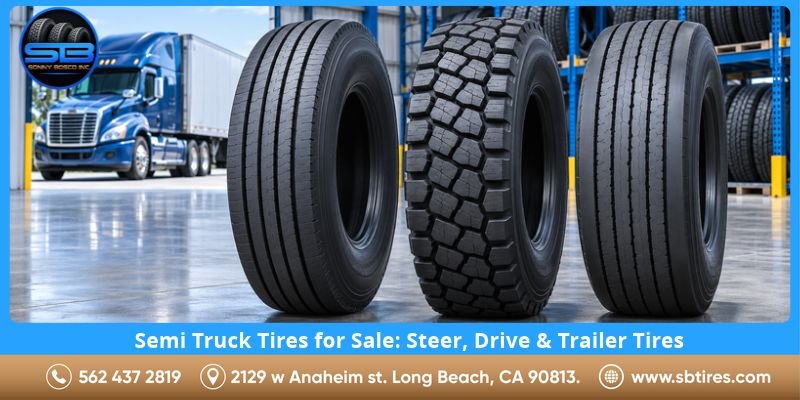
One underinflated drive tire or a sidewall bulge missed during a rushed walkaround can take a loaded truck off the road for hours. A fleet tire checklist gives drivers and maintenance teams a consistent way to check tire pressure, tread depth, visible damage, and service needs before small issues turn into roadside failures. Below, SONNY BOSCO, a commercial truck tire supplier based in Long Beach, California, breaks the inspection down into 10 practical steps.
What Is a Fleet Tire Checklist?
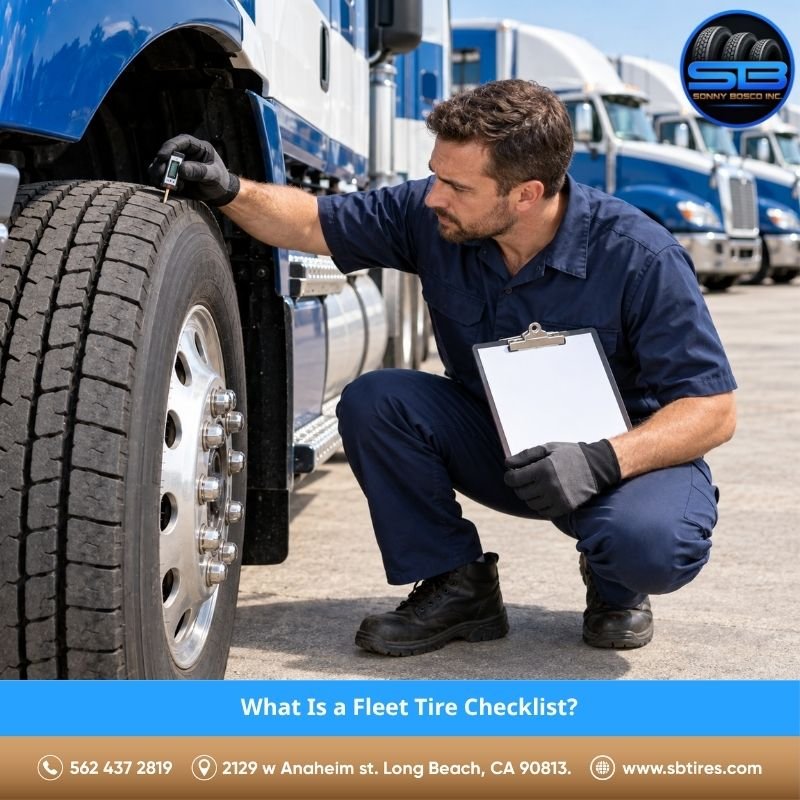
A fleet tire checklist is a standardized inspection form that drivers and technicians use to record the condition of every tire on a commercial vehicle. The main points are:
- Purpose: Turn tire checks into a repeatable routine, so every inspector looks at the same items in the same order;
- Vehicles covered: Commercial trucks, semi trucks, truck tractors, and trailers, including steer, drive, and trailer axle positions;
- Users: Drivers during pre-trip checks, plus fleet maintenance teams during scheduled service;
- Safety role: Catch underinflation, cuts, exposed cords, and leaks before a vehicle leaves the yard;
- Maintenance role: Build a history of tread and pressure readings for each tire position, supporting preventive maintenance and replacement planning.
10 Essential Steps in a Fleet Tire Inspection Checklist
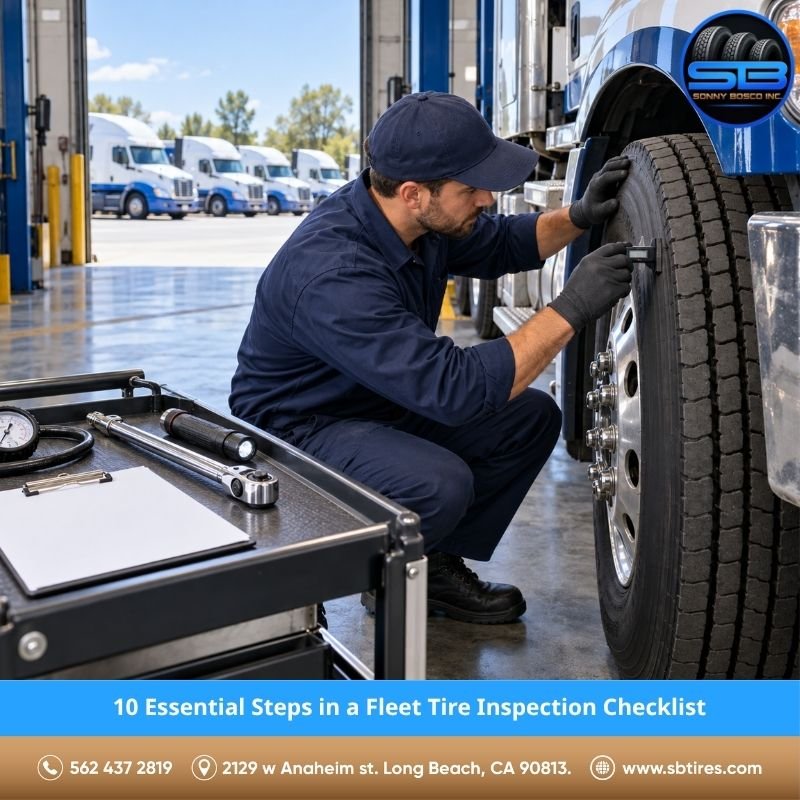
A complete inspection covers tread condition, inflation pressure, visible damage, and the wheel components that hold each tire in place. The steps below follow the order most inspectors use around the vehicle.
1. Record Vehicle and Tire Information
Every inspection starts with basic details, so each reading can be traced back to the right truck and tire position.
- Inspection details: Date, vehicle ID or unit number, odometer reading, and inspector name;
- Tire positions: Label each position as steer, drive, or trailer, including inner and outer duals;
- Tire details: Tire size, load range, and the DOT tire identification number when tracking tire history or warranty claims.
2. Check Tire Tread Depth
Tread depth is one of the clearest indicators of remaining tire life and a common focus of roadside inspections.
- Tool: Use a calibrated tread depth gauge rather than estimating by eye;
- Where to measure: Take readings in major tread grooves, avoiding tie bars, humps, and fillets;
- Across the tread: Measure the inner, center, and outer areas to spot uneven wear early;
- Federal minimums: 4/32 inch for front tires on trucks, truck tractors, and buses, and 2/32 inch for other tire positions under 49 CFR 393.75;
- Recording: Write every reading in 32nds of an inch so trends are easy to compare over time.
3. Measure Tire Inflation Pressure
Correct inflation supports the tire’s load capacity, wear life, and fuel economy, so pressure checks should be precise.
- Cold pressure: Check pressure before the truck has been driven, or after it has been parked long enough for tires to cool;
- Gauge: Use a commercial tire pressure gauge suited to truck pressures, and check its accuracy regularly;
- Correct target: Compare actual PSI with the tire manufacturer’s load and inflation table for the actual axle load, not a single number applied to every truck;
- Dual pairs: Compare the inner and outer tire in each dual set, since a large difference causes the two tires to carry unequal loads.
4. Inspect Tire Sidewalls for Damage
Sidewall damage can lead to sudden failure, so this area deserves a careful look on every inspection.
- Warning signs: Cuts, cracks, bulges, and exposed cords or belt material;
- Both sides: Check the inner sidewall as well as the outer, especially on inner duals where damage is easy to miss;
- Next action: Any bulge, deep cut, or exposed cord means the tire should be taken out of service and inspected by a qualified tire technician.
5. Examine Tire Wear Patterns
The shape of tread wear often reveals mechanical problems before they become expensive.
- Center wear: Commonly linked to overinflation;
- Shoulder wear on both edges: Commonly linked to underinflation or overloading;
- Cupping: Scalloped dips around the tread, often pointing to worn shocks, suspension issues, or wheel imbalance;
- Feathering: Ribs worn sharp on one edge, often a sign of toe misalignment;
- One-sided wear: Frequently related to camber or other alignment problems;
- Recording: Note any abnormal pattern with the tire position, so the maintenance team can diagnose the cause.
6. Inspect Valve Stems and Valve Caps
Small valve problems are a frequent source of slow air loss on commercial trucks.
- Valve stems: Look for cracks, bends, corrosion, or signs of leaking;
- Valve caps: Confirm every cap is present and fitted correctly, since caps help keep dirt and moisture out of the valve core;
- Slow leaks: A tire that repeatedly reads low may have a leaking valve core or stem, which should be tested with soapy water or checked by a technician.
7. Check Dual Tire Assemblies
Dual tires share a load, so a problem on one tire quickly puts extra stress on its partner.
- Separate checks: Inspect the inner and outer tire individually, since a flat inner dual can stay hidden behind a good outer tire;
- Matching: Check that both tires have similar pressure and tread depth, and that sizes and types are compatible;
- Spacing: Look for stones, debris, or other objects trapped between the duals;
- Tire contact: Any sign that the two tires are touching or rubbing needs immediate attention.
8. Inspect Wheels, Rims, and Lug Nuts
A sound tire still needs a sound wheel, so wheel components belong on every tire checklist.
- Wheels and rims: Look for cracks, bends, and damage around the rim flange and bolt holes;
- Fasteners: Check for missing lug nuts, broken studs, and rust streaks or shiny marks that may indicate loosening;
- Torque: Leave torque checks to qualified technicians using the wheel and vehicle manufacturer’s specifications.
9. Check Wheel Alignment and Tire Rotation Needs
Recurring wear problems usually have a cause beyond the tire itself.
- Alignment clues: Feathering, one-sided wear, or wear that returns on replacement tires may indicate an alignment problem;
- Rotation and repositioning: Review whether tires should be rotated or moved to a different position, following vehicle and tire manufacturer guidance;
- Follow-up: Record any suspected alignment or suspension issue as a maintenance task.
10. Document Tire Conditions and Required Actions
The checklist only creates value when results are recorded and acted on.
- Results by position: Record the outcome for every tire position;
- Status: Mark each item as Pass, Fail, or Needs Attention;
- Action type: Note whether the tire needs monitoring, repair assessment, or replacement;
- Ownership: Assign each follow-up action to a responsible person, and keep the records for future comparison.
Printable Fleet Tire Checklist for Commercial Trucks
The form below can be used by drivers and maintenance technicians during routine tire checks.
| Inspection Item | Pass | Fail | N/A |
| Tire identification recorded | ☐ | ☐ | ☐ |
| Tread depth measured | ☐ | ☐ | ☐ |
| Tire pressure checked | ☐ | ☐ | ☐ |
| Sidewall damage inspected | ☐ | ☐ | ☐ |
| Tire wear pattern checked | ☐ | ☐ | ☐ |
| Valve stems and caps inspected | ☐ | ☐ | ☐ |
| Dual tire assemblies inspected | ☐ | ☐ | ☐ |
| Wheels and lug nuts checked | ☐ | ☐ | ☐ |
| Alignment-related wear reviewed | ☐ | ☐ | ☐ |
| Results and follow-up recorded | ☐ | ☐ | ☐ |
DOT and FMCSA Tire Inspection Requirements for Commercial Fleets
Federal tire rules for U.S. commercial motor vehicles are set by the Federal Motor Carrier Safety Administration (FMCSA), an agency of the U.S. Department of Transportation. These rules set legal minimums, which are different from the stricter targets many fleets use for preventive maintenance.
| Condition | Legal defect under federal rules | Fleet maintenance warning sign |
| Tread depth | Below 4/32 inch (front) or 2/32 inch (other positions) | Approaching the fleet’s internal pull point |
| Damage | Exposed ply or belt, separation, cut to the cords | Small cuts, cracking, minor bulging |
| Air loss | Flat tire or audible leak | Repeated low readings, pressure gap between duals |
| Inflation | Below the pressure specified for the load | Slightly under target pressure |
| Wear | Not a defect unless tread falls below the minimum | Feathering, cupping, one-sided wear |
How Often Should Fleet Tires Be Inspected?
Inspection frequency works best when it is organized by the level of detail, rather than repeating every measurement at the same interval. The framework below is a common fleet management approach, not a universal schedule set by FMCSA.
| Frequency | Level of detail | Main focus |
| Daily | Visual walkaround | Obvious damage, low tires, leaks |
| Weekly | Closer inspection with a gauge | Pressure, wear, duals, valves |
| Monthly | Full measured inspection | Tread data, trends, replacement planning |
Common Fleet Tire Problems and When to Replace Tires
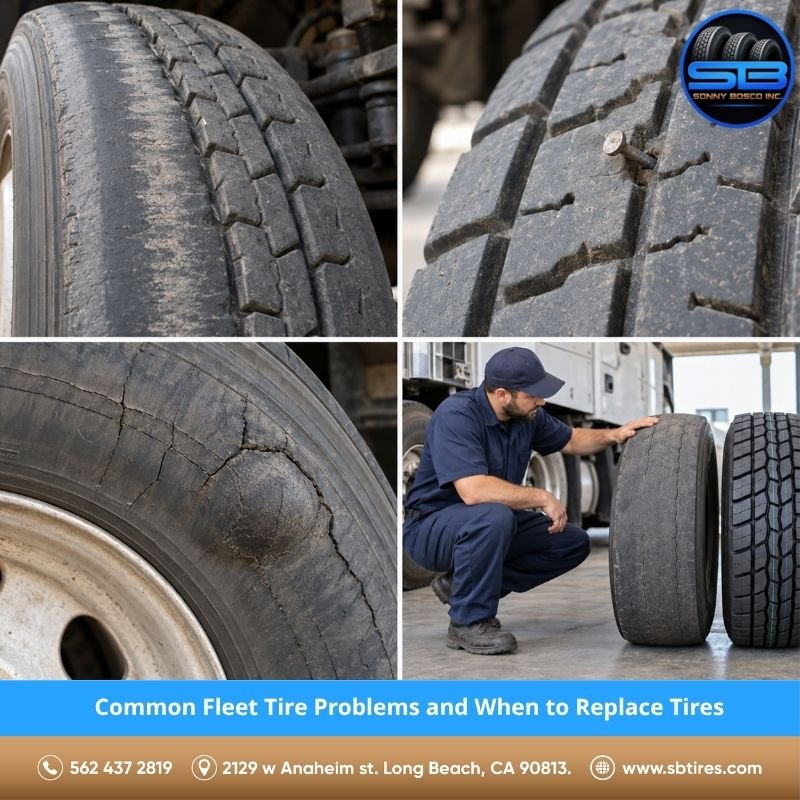
Some tire problems need monitoring, while others mean the tire should come off the vehicle right away. The issues below deserve priority on any fleet tire checklist.
Low Tire Pressure and Repeated Air Loss
A tire that keeps losing air usually has a specific cause that needs to be found.
- Common causes: Leaking valve cores or stems, punctures, damaged wheels, or poor bead seating;
- When to escalate: A tire that loses pressure repeatedly, or was run significantly underinflated, should be inspected by a qualified technician before returning to service.
Uneven or Excessive Tread Wear
Abnormal wear shortens tire life and often signals a mechanical issue.
- Linked causes: Incorrect inflation, misalignment, worn suspension parts, and wheel imbalance;
- Why records matter: Tread readings tracked over time show how fast each position wears, making problem axles easy to identify.
Sidewall Bulges, Cuts, and Structural Damage
Structural damage is among the most serious tire conditions a driver can find.
- Warning signs: Bulges, deep cuts, exposed cords, and separation of the tread or sidewall;
- Required action: Remove the tire from operation and have it inspected by a qualified tire professional.
Tire Replacement and Maintenance Planning
Replacement decisions should be planned, not forced by a roadside failure.
- Decision factors: Remaining tread, damage history, load requirements, and operating conditions such as regional, long-haul, or vocational routes;
- Internal pull points: Many fleets replace tires before they reach the legal minimum, especially in steer positions;
- Planning with data: Inspection records help predict when tires will need replacement and reduce unexpected downtime.
How a Fleet Tire Checklist Helps Reduce Operating Costs
Tires are one of the largest maintenance expenses for most fleets, and consistent monitoring helps control that spending. The main benefits include:
- Longer usable tire life: Early detection of uneven wear lets the fleet fix the cause before the tire is ruined;
- Less unexpected downtime: Finding defects before a trip helps prevent avoidable tire-related breakdowns;
- Better fuel efficiency: Proper inflation reduces unnecessary rolling resistance;
- Smarter maintenance planning: Inspection records help teams prioritize service and schedule replacements;
- Tire cost per mile tracking: Comparing purchase, repair, and replacement costs against the mileage each tire delivers shows which tires and practices offer the best value.
Commercial Truck Tires for Fleet Operations at SONNY BOSCO
A good inspection routine also depends on starting with the right tire for each application. Here is what fleets should consider:
- Correct fitment: Choose tires with the right size, load range, and intended axle position, whether steer, drive, or trailer;
- Matched duals: Replace and pair dual tires with compatible size and tread depth;
- DRC commercial tires: SONNY BOSCO is the exclusive U.S. partner of DRC, supplying radial and bias tires manufactured in Vietnam for commercial and heavy-duty applications;
- Fleet and wholesale support: Fleet operators and wholesale buyers can contact SONNY BOSCO for advice on suitable commercial truck tires and wholesale pricing.
Frequently Asked Questions About Fleet Tire Inspections
What should be included in a fleet tire checklist?
A fleet tire checklist should cover tread depth, inflation pressure, sidewall damage, wear patterns, valve stems, dual assemblies, wheels, and lug nuts. It should also record vehicle details, results by tire position, and any follow-up actions.
How often should commercial truck tires be inspected?
Commercial truck tires should get a visual check before every trip. Many fleets add weekly pressure checks and monthly full tread measurements as part of their maintenance program.
What is the minimum DOT tread depth for commercial truck tires?
Under 49 CFR 393.75, front tires on buses, trucks, and truck tractors need at least 4/32 inch of tread depth, while all other positions need at least 2/32 inch. Tread depth is measured in a major tread groove, not on tie bars, humps, or fillets.
What tire pressure should a fleet truck use?
There is no single correct pressure for every truck, because the right PSI depends on the tire and the load it carries. Check pressure when tires are cold and compare it with the tire manufacturer’s load and inflation table.
When should a commercial truck tire be replaced?
A tire should be replaced when its tread reaches the fleet’s pull point or the legal minimum. Tires with bulges, exposed cords, separation, or cuts reaching the ply or belt should be removed from service immediately.
Can fleet tire inspections prevent roadside breakdowns?
Regular inspections cannot remove every risk, but they help prevent many tire-related breakdowns by catching low pressure, slow leaks, and damage before a failure occurs.
Through this fleet tire checklist, fleets can keep a closer watch on tire pressure, tread depth, visible damage, and maintenance records, helping trucks stay safe, compliant, and on the road. When it is time to replace tires or choose the right commercial truck tires for your routes, contact SONNY BOSCO at Hotline: 562 437 2819, email Sbvnopt@gmail.com, or visit sbtires.com for product information and wholesale inquiries.