Following the right tire maintenance tips is one of the simplest ways to keep a commercial truck safe, compliant, and profitable on the road. A single neglected tire can lead to a roadside breakdown, a costly out-of-service violation, or a delivery that never arrives on time. For fleets running heavy loads every day, small habits like checking pressure and measuring tread add up to longer tire life and lower operating costs. In this guide, SONNY BOSCO, a commercial truck tire and heavy-duty parts business in Long Beach, shares practical inspection steps, a quick-reference checklist, common wear problems, and clear signs that a tire needs replacement.
Why Is Regular Tire Maintenance Important?
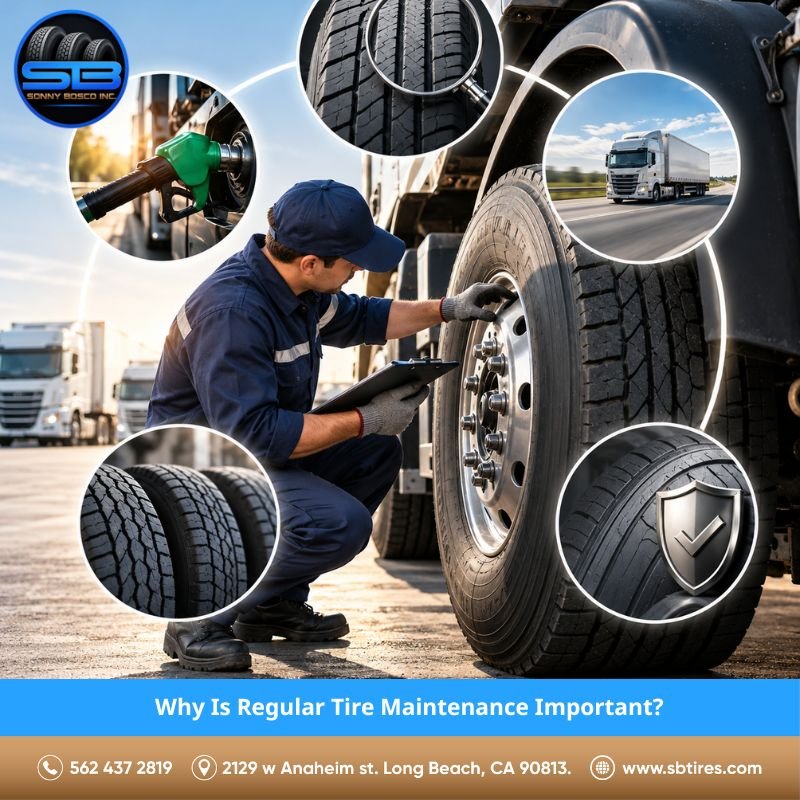
Commercial truck tires carry tens of thousands of pounds across long distances, so their condition affects safety, costs, and daily fleet operations. Regular commercial truck tire maintenance delivers these key benefits:
- Improved road safety: Good tread and correct pressure support traction, handling, and braking, especially under heavy loads;
- Lower blowout risk: Proper inflation and load control reduce the heat buildup that causes sudden tire failure;
- Longer tire life: Even tread wear helps tires stay in service longer and keeps casings suitable for retreading;
- Reduced replacement costs: Catching problems early often means a simple repair or adjustment instead of a new tire;
- Better fuel efficiency: Correctly inflated tires have lower rolling resistance, helping trucks use less fuel;
- Less unexpected downtime: Planned tire service during scheduled maintenance prevents costly roadside breakdowns.
10 Essential Tire Maintenance Tips for Commercial Trucks
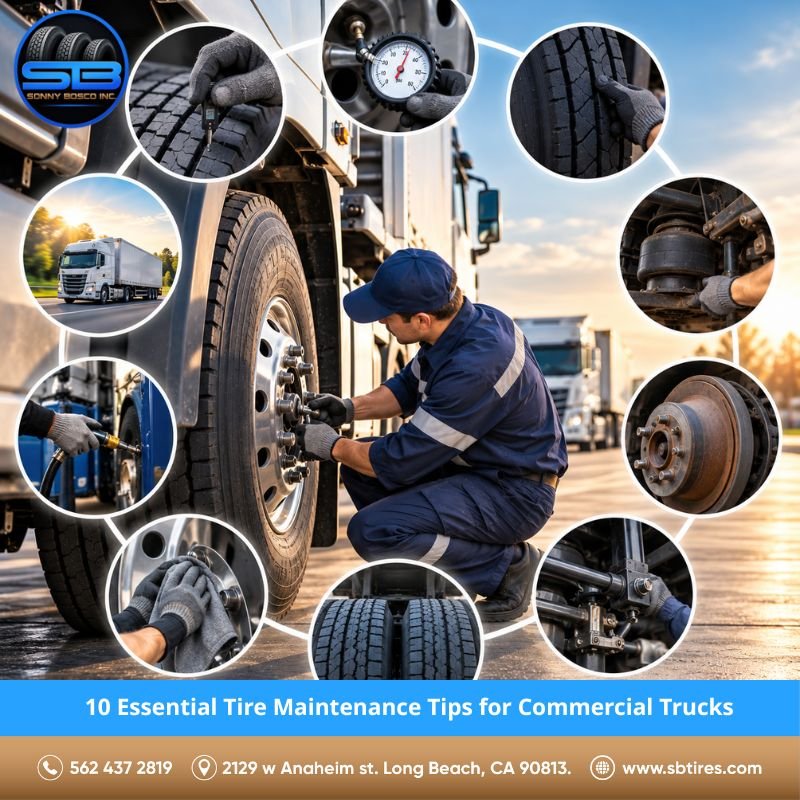
The following tire maintenance tips cover the most important practices for drivers, technicians, and fleet managers. Each tip explains how to perform the check, how often to do it, and which warning signs to watch for.
1. Check Tire Pressure Regularly
Correct inflation is the foundation of every truck tire maintenance program, because pressure affects wear, heat, fuel use, and load capacity. Always use a calibrated tire pressure gauge and measure when tires are cold, either before driving or after the truck has been parked for several hours. Thumping a tire with a mallet cannot reliably detect underinflation.
Set pressure according to the tire manufacturer’s load and inflation tables and the actual weight on each axle. Check every dual tire individually, since a low inner dual is easy to miss and can damage both tires. Never release air from a hot tire, because it will be underinflated once it cools down.
2. Inspect Tire Tread Depth and Wear
Tread depth determines traction and is one of the most common causes of roadside inspection violations. Use a tread depth gauge to measure in a major groove at several points around the tire, not on the wear bars. Under FMCSA rules, front steering tires on buses, trucks, and truck tractors need at least 4/32 of an inch of tread, while all other tires need at least 2/32 of an inch, measured in a major tread groove.
Many well-managed fleets pull steer tires at 6/32″ to keep a safety margin above the legal minimum. If readings differ across the inner, center, and outer grooves, the tire is wearing irregularly and needs a closer inspection to find the cause.
3. Look for Tire Damage and Sidewall Problems
Visible damage can make a tire unsafe long before the tread wears out. During every walkaround, check the tread and both sidewalls for cuts, cracks, bulges, and embedded objects such as nails, stones, or metal debris. A bulge usually signals internal damage or separation inside the tire.
Some conditions mean the tire must come out of service immediately. Exposed body ply or belt material in the tread or sidewall, along with any tread or sidewall separation, makes a tire unsafe to operate. Minor cuts or small embedded objects should still be checked by a qualified technician before the next trip.
4. Follow the Correct Tire Rotation Schedule
Tire rotation helps even out wear patterns and extend usable tread life, but heavy trucks follow very different rules than passenger cars. Steer, drive, and trailer tires often have different tread designs, so they are not always interchangeable between positions.
Many truck tire manufacturers recommend rotating based on wear condition rather than a fixed mileage interval. Applying a passenger car rotation schedule to a heavy-duty truck can waste labor or move tires into unsuitable positions, so always follow the manufacturer’s guidance for your specific tires.
5. Check Wheel Alignment
Poor wheel alignment is one of the most common causes of rapid and uneven tire wear on commercial trucks. Warning signs include the truck pulling to one side on a straight road, a steering wheel that sits off center, and one tire shoulder wearing faster than the other, especially on steer tires.
Misalignment forces tires to scrub against the road instead of rolling cleanly, which shortens tire life quickly. Have alignment checked by a qualified shop when these symptoms appear, after suspension repairs, or after a hard impact with a curb or pothole.
6. Maintain Proper Wheel Balancing
Tire balancing keeps weight evenly distributed around the wheel so the tire rolls smoothly at highway speed. An unbalanced wheel often causes vibration in the steering wheel, seat, or cab floor, along with scalloped or patchy wear spots around the tread.
Imbalance also adds stress to suspension components and increases driver fatigue on long hauls. Balance should be checked when mounting new tires, after a tire repair, or whenever drivers report vibration.
7. Avoid Overloading Commercial Truck Tires
Every tire has a maximum load rating marked on the sidewall, together with the inflation pressure required to carry that load. Trucks must also stay within federal and state axle weight limits in addition to gross vehicle weight limits.
Overloading increases sidewall flexing, which builds heat and speeds up tire breakdown. Match tire size and load range to the truck’s application, and follow both manufacturer specifications and applicable weight regulations when planning loads.
8. Inspect Tire Valves and Wheel Components
Air leaks often start at the valve or wheel rather than in the tire itself. Check valve stems for cracks, bends, or damage, paying extra attention to inner dual valves that are harder to reach. Keep valve caps installed to block dirt and moisture, and listen for hissing or watch for one tire running lower than the others.
Wheels and rims should be inspected for cracks, bent flanges, rust trails around lug nuts, and loose or missing fasteners. Because wheel-end problems involve high pressure and heavy components, repairs should always be handled by trained technicians.
9. Monitor Tire Temperature and Operating Conditions
Heat is a major cause of tire failure. Underinflation, overloading, and long runs at highway speed all raise tire temperature, while rough roads, construction zones, and debris increase the risk of cuts and impact damage. Hard braking, sharp turns, and curb strikes also accelerate wear.
Drivers should pull over safely and inspect the tires if they notice a burning smell, smoke, sudden vibration, a pull to one side, or a tire that looks visibly low. Early action can prevent a minor issue from becoming a blowout.
10. Keep Tire Maintenance Records
Good records turn individual inspections into useful data for fleet tire maintenance planning. Each record should include tire pressure, tread depth, tire position, mileage, inspection findings, and any repairs or corrective actions taken.
Over time, these records reveal recurring problems on specific trucks or routes, along with replacement history and casing retread status. Fleet managers can use this information to forecast tire budgets and schedule replacements before problems cause downtime.
Common Tire Wear Problems and What They Mean
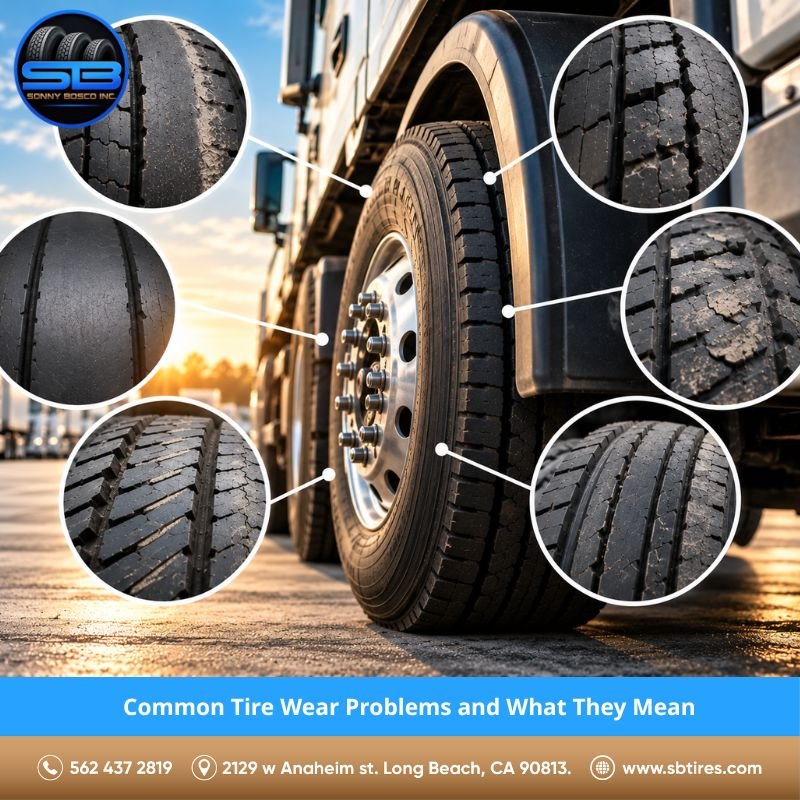
Tire wear patterns can point toward mechanical or operating problems, but they should be treated as clues rather than final diagnoses.
Uneven Tire Wear
Uneven tire wear often develops gradually, so regular tread measurements across the full width of the tire are the best way to catch it early. The most common patterns include:
- One-sided wear: Often linked to alignment or suspension problems;
- Center wear: May indicate inflation that is too high for the load the tire is carrying;
- Shoulder wear: May point to underinflation, overloading, or other operating issues.
Tire Cupping and Irregular Tread Wear
Cupping appears as alternating high and low spots around the tread and usually signals a problem outside the tire itself. Technicians should look at the full picture:
- Possible causes: Worn suspension components, wheel-end problems, imbalance, or misalignment;
- Find the root cause: Replacing the tire without correcting the underlying issue will cause the same wear on the new tire.
Repeated Tire Pressure Loss
A tire that keeps losing air is warning you about a problem that will not fix itself. Common sources and the right response include:
- Possible sources: Valve leaks, punctures, bead leaks, or cracked and damaged wheels;
- Professional assessment: Remove the tire for inspection instead of repeatedly adding air without a diagnosis;
- Safety caution: A tire that has been run severely underinflated may have internal damage, so reinflation should only be done by trained personnel using a safety cage.
When Should Commercial Truck Tires Be Replaced?
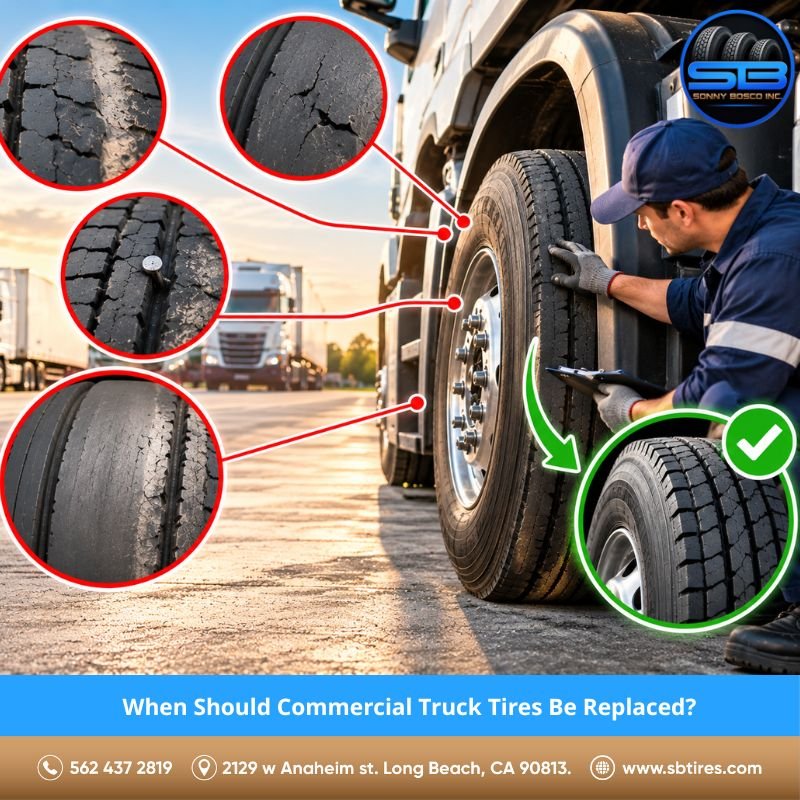
Commercial truck tire replacement decisions should be based on measurable safety criteria and physical tire condition, not mileage alone. Replace or remove a tire for professional assessment when you notice these signs:
- Tread below legal limits: Steer tires under 4/32 of an inch or drive and trailer tires under 2/32 of an inch must be replaced;
- Bulges or separations: These signal internal structural damage and require immediate removal;
- Exposed cords or belts: Visible steel or fabric in the tread or sidewall means the tire is unsafe to operate;
- Severe cuts or punctures: Damage that reaches the casing or falls outside repairable limits calls for replacement;
- Flat tires or repeated air loss: A tire that cannot hold pressure should come out of service until inspected;
- Aging or severe irregular wear: Sidewall cracking, uneven tread, and a history of repairs or underinflation warrant replacement based on manufacturer guidance.
Why Choose SONNY BOSCO for Commercial Truck Tire Services?
Choosing the right tire provider makes it easier for fleets and trucking businesses to apply these maintenance practices consistently. SONNY BOSCO is a commercial truck tire and heavy-duty truck parts business at 2129 W Anaheim St, Long Beach, CA 90813, offering practical support in these areas:
- Commercial tire knowledge: Understanding the differences between steer, drive, and trailer tires for regional, long-haul, and local operations;
- Matching specifications: Recommending tires based on truck type, axle position, load requirements, and operating conditions;
- Replacement guidance: Helping customers find suitable replacement tires instead of guessing from size alone;
- Tire condition review: Discussing tread wear, inflation issues, visible damage, and whether a tire needs repair or replacement;
- Convenient Long Beach location: An easy contact point for fleets operating around the Port of Long Beach and the wider Los Angeles area.
For product availability and service inquiries, contact SONNY BOSCO via Hotline: 562 437 2819, email Sbvnopt@gmail.com, or visit sbtires.com.
Frequently Asked Questions About Tire Maintenance
How Often Should Commercial Truck Tires Be Inspected?
Drivers should check tires visually before every trip. Pressure should be measured with a calibrated gauge at least weekly, while tread depth and wheel components are checked during scheduled maintenance.
What Is the Correct Tire Pressure for a Semi Truck?
There is no single correct pressure for every semi truck. Set cold pressure according to the tire manufacturer’s load and inflation tables based on the actual weight on each axle.
How Often Should Truck Tires Be Rotated?
Commercial truck tires have no fixed rotation interval. Rotation depends on axle position, tread design, wear condition, and manufacturer recommendations.
What Causes Uneven Tire Wear on Commercial Trucks?
Common causes include incorrect inflation, misalignment, worn suspension parts, imbalance, overloading, and mismatched dual tires. A qualified technician should identify the root cause before the tire is replaced.
Can a Commercial Truck Tire Be Repaired Instead of Replaced?
Yes, small tread-area punctures within the manufacturer’s repair limits can usually be repaired from inside the tire by a qualified technician. Sidewall damage, exposed cords, and separations require replacement, and many carriers choose not to run repaired tires on the steer axle.
How Can Fleet Managers Extend Truck Tire Life?
Maintain correct inflation, monitor tread depth, fix alignment and balance issues early, and avoid overloading. Keeping detailed tire records and protecting casings for retreading also lowers long-term tire costs.
Applying these tire maintenance tips consistently helps commercial trucks stay safer, more compliant, and more cost-efficient on every route. Regular inspections, correct inflation pressure, careful tread monitoring, and preventive maintenance allow drivers and fleet managers to catch small tire problems before they turn into roadside breakdowns or unexpected downtime. We hope this guide gives you a practical routine to apply to your trucks starting today. Follow SONNY BOSCO at sbtires.com for more useful insights on commercial truck tires and heavy-duty truck parts.