Choosing the right heavy-duty tires affects more than how a truck performs on the road. The right choice can help reduce fuel costs, minimize downtime, and improve transportation safety. Whether you operate a single semi-truck, manage a growing fleet, or purchase tires in volume, SONNY BOSCO supplies commercial truck tires designed for demanding working conditions. Browse our product range or request a wholesale quote to find the right tires for your trucks.
Heavy Duty Tires for Sale at SONNY BOSCO

Explore our range of heavy-duty tires for sale and compare product specifications based on your vehicle and operating requirements.
- Tire size: Common fitments such as 11R22.5, 295/75R22.5, and 11R24.5;
- Tire type: Steer, drive, trailer, and all-position tires;
- Application: Long-haul, regional, mixed-service, and on-/off-road applications;
- Load range: Select the appropriate load range based on your axle weight;
- Product details: Review tire models, sizes, load ratings, ply ratings, and key features;
- Pricing and quotes: Contact our team for current pricing and volume orders.
Types of Heavy Duty Truck Tires

Before selecting a tire size, it is important to identify where each tire will be mounted. Different axle positions place different demands on heavy-duty commercial truck tires.
Heavy Duty Steer Tires
Steer tires are mounted on the front steering axle and play an important role in directional control, handling, and even tread wear.
- Directional stability: Rib tread designs help trucks maintain directional stability and respond smoothly to steering input;
- Even wear: Optimized shoulder designs help minimize irregular wear patterns such as cupping and river wear;
- Tread depth: New steer tires may have an original tread depth of approximately 16/32 to 19/32 of an inch, depending on the model;
- Safety requirements: FMCSA regulations require a minimum tread depth of 4/32 of an inch on front tires and 2/32 of an inch on other tires.
Heavy Duty Drive Tires
Drive tires are mounted on powered axles and transfer engine torque to the road, providing the traction needed to move commercial vehicles.
- Traction: Deep lug or block tread patterns provide grip on wet roads, steep grades, and loose surfaces;
- Tread depth: Many drive tires feature tread depths between 24/32 and 32/32 of an inch, depending on the application;
- Closed-shoulder design: Helps improve tread wear and fuel efficiency on highway routes;
- Open-shoulder design: Provides additional traction in rain, snow, and mixed-service conditions.
Heavy Duty Trailer Tires
Trailer tires are mounted on non-powered axles and carry a significant portion of the vehicle’s total load.
- Load support: Durable casings and sidewalls are designed to support heavy loads over long distances;
- Scrub resistance: Specialized compounds help resist scuffing caused by tight turns and dock maneuvers;
- Low rolling resistance: Shallower tread designs, often ranging from 10/32 to 14/32 of an inch, can help improve fuel efficiency.
Heavy Duty All-Position Tires
All-position tires are designed for use on multiple approved axle positions, helping commercial fleets simplify tire inventory and replacement planning.
- Flexible fitment: Suitable for steer, drive, or trailer applications where approved by the manufacturer;
- Common applications: Regional transportation, pickup and delivery operations, buses, and vocational trucks;
- Approved positions: Always confirm axle compatibility and load ratings in the manufacturer’s technical data before mounting.
Heavy Duty Tires by Truck Application
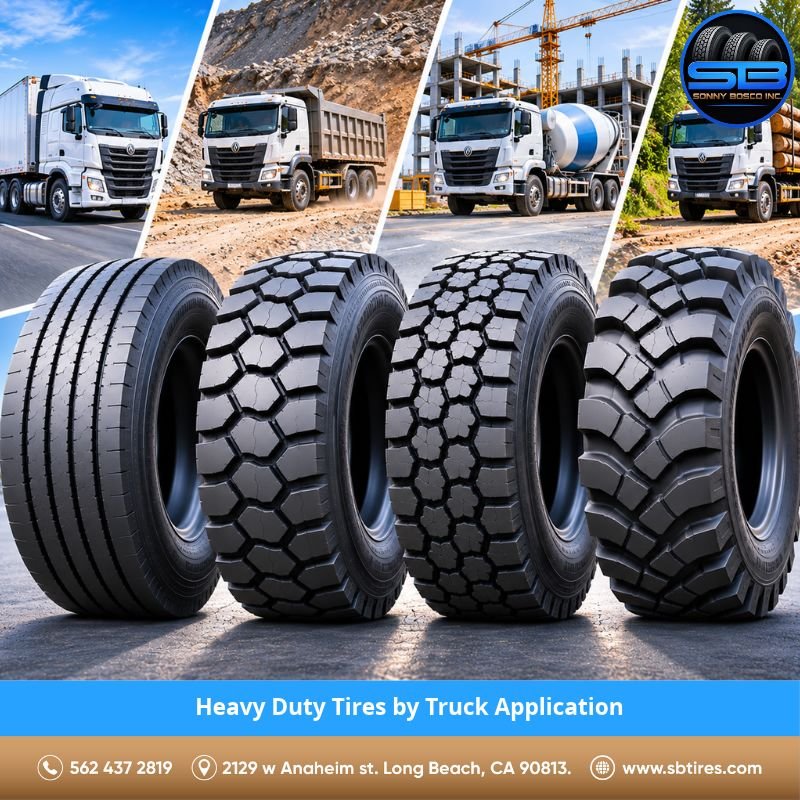
Beyond axle position, the type of truck, operating conditions, and daily transportation requirements determine which tire is most suitable for your business.
Heavy Duty Tires for Semi-Trucks
Semi-truck tires need to balance mileage, fuel efficiency, load capacity, and stable handling over long distances.
- Long-haul applications: Low rolling resistance and extended tread life for interstate transportation;
- Regional applications: Durable casings and compounds designed for frequent stops, turns, and changing road surfaces;
- Highway fitments: 295/75R22.5 and 11R22.5 are among the common tire sizes used on Class 8 tractors.
Heavy Duty Tires for Dump Trucks and Construction Vehicles
Dump trucks and construction vehicles frequently operate on sharp rocks, steep grades, and uneven surfaces while transitioning between paved roads and construction sites.
- Mixed-service tread: Aggressive lug patterns provide traction on gravel, mud, and unpaved haul roads;
- Cut and chip resistance: Specialized compounds help protect the tread from rocks and debris;
- Reinforced casings: Durable construction helps support heavy payloads and withstand demanding operating conditions;
- Common sizes: 11R22.5 and 11R24.5 with Load Range H are common options for certain vocational trucks.
Heavy Duty Tires for Commercial Fleets
For fleet managers, heavy-duty fleet tires represent a long-term operating cost rather than a one-time purchase. Selecting suitable tires can help improve operational efficiency and control maintenance expenses.
- Annual mileage: High-mileage routes benefit from long-wearing, fuel-efficient tire designs;
- Axle loads: Selecting appropriate load ranges helps keep trucks within safe operating limits;
- Replacement cycles: Planning replacements based on tread depth and tire condition helps reduce unexpected downtime;
- Retreadability: A suitable casing can be retreaded to help reduce costs over the tire’s service life.
Heavy Duty Tire Sizes and Specifications
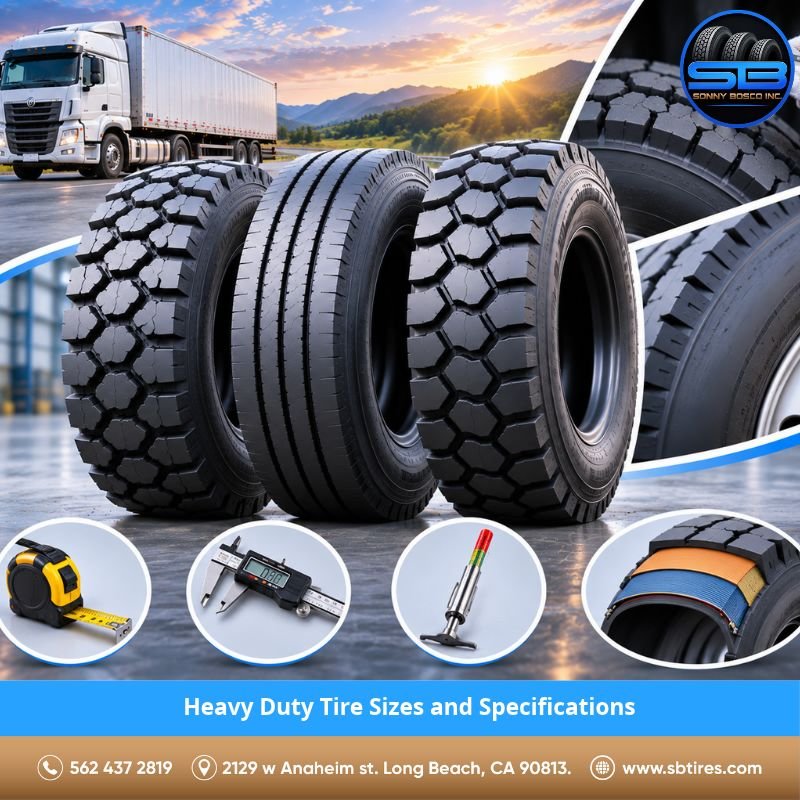
Heavy-duty tires are available in various sizes, load ratings, and constructions to accommodate different commercial trucks and operating conditions. Key specifications to consider include:
- Common tire sizes: 11R22.5, 295/75R22.5, 11R24.5, and 285/75R24.5.
- Load range: Load Ranges G and H are commonly used for commercial trucks.
- Ply rating: Load Range G corresponds to 14-ply, while Load Range H corresponds to 16-ply.
- Load index: Indicates the rated load capacity in single and dual configurations.
- Inflation pressure: Determined by the actual tire load and manufacturer’s specifications.
- Tire construction: Radial and bias designs offer different performance characteristics.
How to Choose the Right Heavy Duty Tires
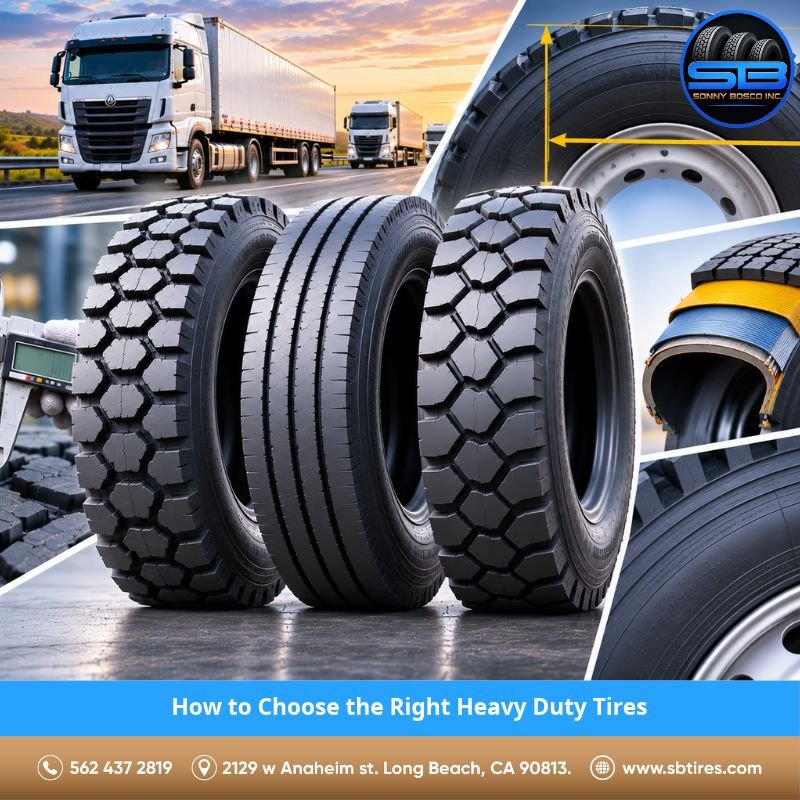
Selecting suitable heavy-duty tires involves several practical factors that fleet managers and B2B buyers should consider before placing an order.
Choose Tires Based on Axle Position
Start by identifying the axle position where each tire will be mounted.
- Steer axle: Prioritize handling, even tread wear, and applicable tread depth requirements;
- Drive axle: Select a tread pattern that provides suitable traction for your operating conditions;
- Trailer axle: Consider load capacity, scrub resistance, and rolling resistance;
- All-position tires: Mount tires only on axle positions approved by the manufacturer.
Match Tire Size and Load Capacity
Every tire must support its actual operating load at the appropriate inflation pressure. Choosing incompatible tires can increase wear and compromise vehicle safety.
- Check vehicle specifications: Confirm the recommended tire size and wheel dimensions;
- Determine tire loads: Use actual loaded vehicle weights and consider axle configuration and weight distribution;
- Review load ratings: The applicable single or dual load rating must meet or exceed the actual tire load;
- Check wheel compatibility: Confirm that the tire size, rim width, wheel diameter, and wheel load capacity are compatible.
Consider Road Conditions and Tread Patterns
Different driving environments require different tread designs and performance characteristics.
- Highway: Rib tread patterns and fuel-efficient compounds for long, steady routes;
- Regional: Durable tread designs that withstand frequent turns, stops, and urban traffic;
- Mixed service: Aggressive tread patterns suitable for paved roads and construction sites;
- Off-road: Deep lug patterns and cut-resistant compounds for demanding unpaved environments.
Evaluate Tire Durability and Cost per Mile
The lowest purchase price does not always result in the lowest operating cost. Fleet managers should consider long-term performance when comparing commercial truck tires.
- Cost-per-mile formula: Divide the total tire cost by the number of miles delivered;
- Practical example: A $450 tire that delivers 120,000 miles costs approximately 0.375 cents per mile, while a $300 tire that delivers 60,000 miles costs 0.5 cents per mile;
- Tread life: Evaluate tread depth, wear resistance, operating conditions, and maintenance requirements;
- Casing value: A suitable retreadable casing may provide additional value after the original tread reaches the end of its service life;
- Fuel savings: Low rolling resistance designs can help reduce fuel consumption on long-haul routes.
Heavy Duty Tire Prices and Wholesale Quotes
Heavy-duty tire prices typically range from $200 to $700 per tire, depending on tire size, construction, load capacity, and application. Below are estimated market prices for common commercial truck tires.
| ire Type | Estimated Price (USD/Tire) |
| Steer tires (11R22.5, 295/75R22.5) | 250–550 |
| Drive tires | 280–600 |
| Trailer tires | 200–450 |
| All-position tires | 250–500 |
| Mixed-service and dump truck tires | 350–700 |
Why Buy Heavy Duty Tires from SONNY BOSCO?
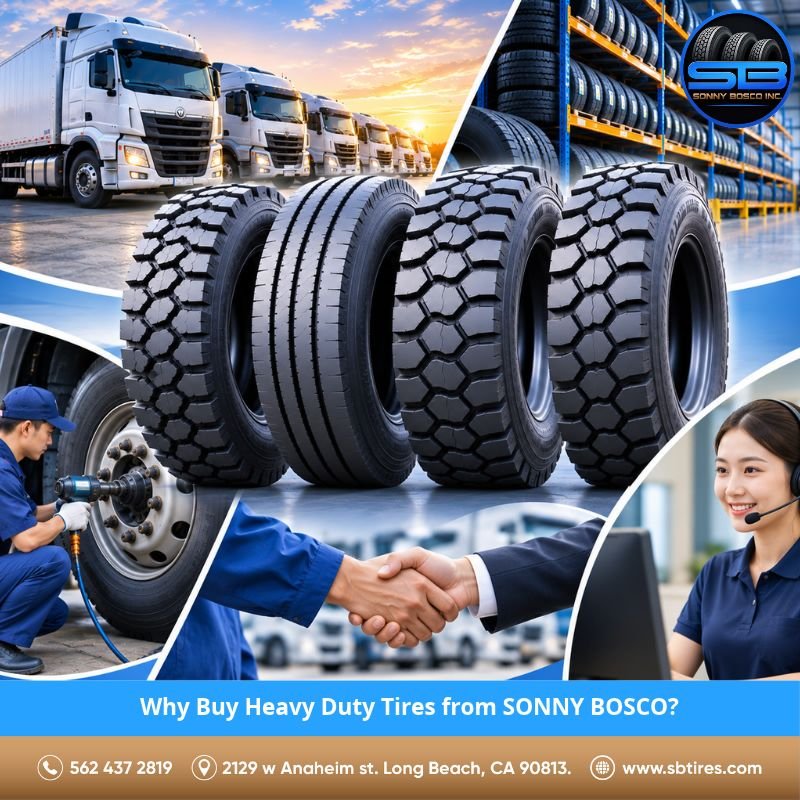
SONNY BOSCO supplies heavy-duty tires to transportation businesses, fleet operators, tire dealers, and distributors across the U.S. market. Purchasing from us offers several advantages:
- Reliable DRC tire sourcing: Access to DRC commercial truck tires with traceable product origins.
- Quality construction: Durable casings and steel-belted radial designs for demanding commercial applications.
- Diverse product selection: Multiple tire sizes, load ratings, tread patterns, and axle positions.
- Wholesale pricing: Customized quotes for fleets, dealers, and bulk orders.
- Technical support: Professional guidance on tire selection, load capacity, and operating conditions.
- Convenient location: Based in Long Beach, California, near major ports and freight routes.
Contact SONNY BOSCO:
- Address: 2129 W Anaheim St, Long Beach, CA 90813.
- Phone: (562) 437-2819.
- Email: Sbvnopt@gmail.com.
- Website: sbtires.com.
Frequently Asked Questions About Heavy Duty Tires
What are heavy-duty tires?
Heavy-duty tires are designed for vehicles that require greater load-carrying capacity and durability under demanding operating conditions. In commercial trucking, these tires are commonly used on semi-trucks, dump trucks, buses, and trailers.
What is the difference between heavy-duty tires and regular tires?
Heavy-duty truck tires typically feature stronger casings and higher load capacities than standard passenger vehicle tires. Their construction, tread designs, and load ratings are developed to meet the requirements of commercial transportation.
What load range do heavy-duty truck tires need?
Load Ranges G (14-ply rating) and H (16-ply rating) are common in commercial truck applications. Select a tire with a load rating that meets or exceeds the actual operating load and complies with the manufacturer’s specifications.
How long do heavy-duty truck tires last?
The service life of heavy-duty truck tires depends on axle position, tread design, operating conditions, load, inflation pressure, and maintenance practices. A suitable casing may also be retreaded to extend its overall service life.
Where can I buy heavy-duty tires in California?
You can purchase commercial truck tires from SONNY BOSCO at 2129 W Anaheim St, Long Beach, CA 90813. Call (562) 437-2819 to check product availability and request a quote for your fleet or business.
Choosing the right heavy-duty tires can help your trucks carry loads safely, reduce operating costs, and maintain reliable performance. For product information, tire selection advice, or wholesale pricing, contact SONNY BOSCO at (562) 437-2819 or visit sbtires.com today.